What it is
Symbolab is a web and mobile mathematics platform that interprets typed or photographed problems and applies calculators and solver workflows across areas such as algebra, calculus, trigonometry, statistics, and related subjects. It can expose intermediate steps, graph expressions, and support practice. The educational value depends on how it is used: a learner gains more by predicting the next transformation, comparing it with Symbolab, and explaining the rule than by copying a final answer.
Test bench
- Scope
- logged-out evaluation
- Checked
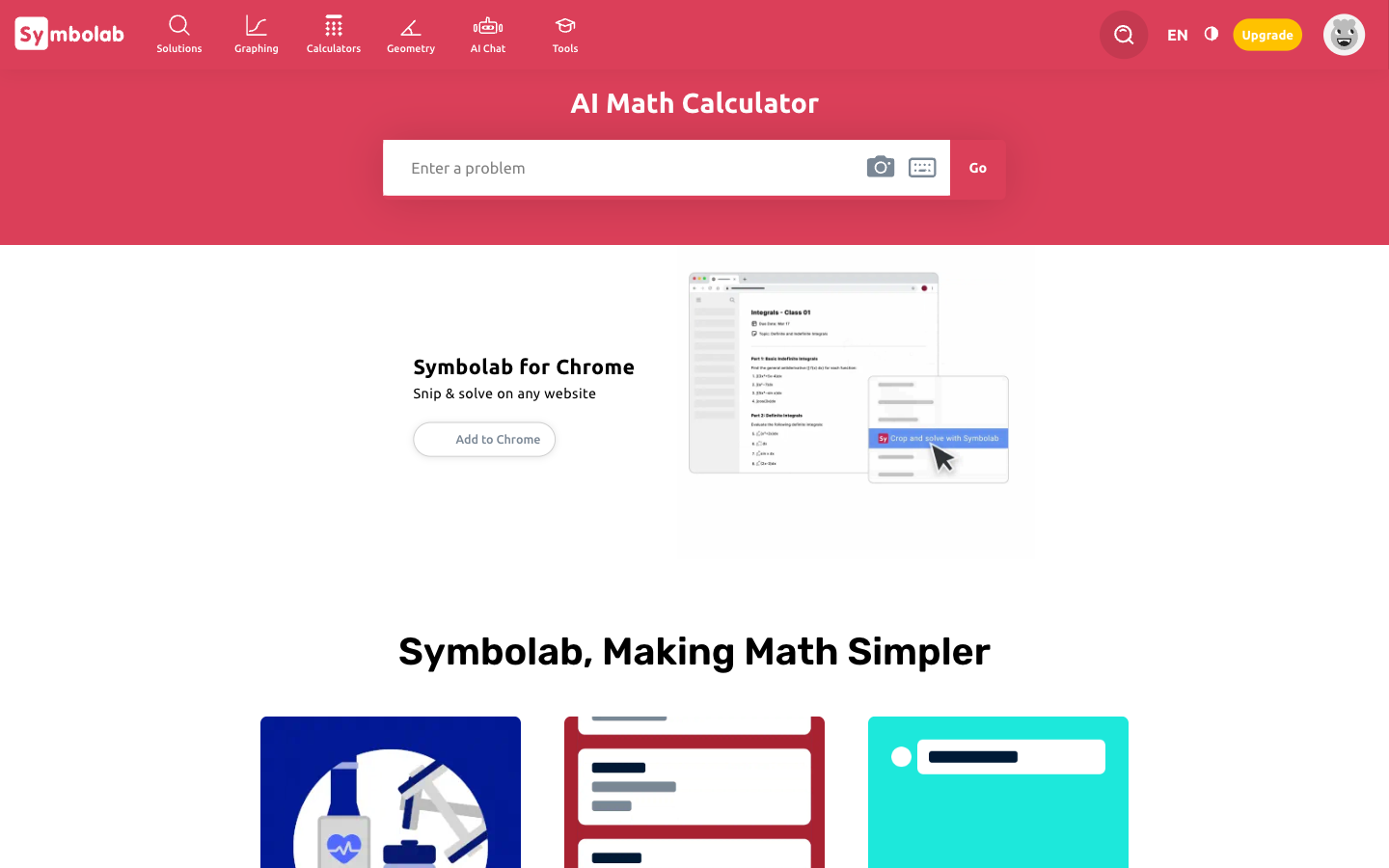
We evaluated the public solver path for a calculus learner checking an integral: enter the expression, confirm how it was parsed, inspect each transformation, predict the next step, and verify the result independently. The learning value comes from comparison, not answer copying.
Account boundary: The public solver, product explanations, FAQ, and subscription page were checked. Full paid step access, saved notebooks, mobile capture, and account-specific practice were not purchased, so no locked explanation is represented as a hands-on result.
-
Confirm the parsed problem
A correct-looking answer can solve the wrong expression if parentheses, exponents, domains, or notation were interpreted differently than intended.
-
Predict before revealing a step
Step-by-step output is most educational when the learner names the next rule first, then compares the solver's transformation and explains any difference.
-
Verify outside the solver
Substitution, differentiation, estimation, graphing, or a second method can test whether the final result and its domain make sense.
- 1
Parsed expressionCompare the displayed notation with the original problem before reading any solution.
- 2
Transformation stepsName the rule behind each line and identify conditions where it is valid.
- 3
Independent checkSubstitute, differentiate, graph, or estimate the result outside the shown path.
Best for—and when to skip it
Best for
- Checking multi-step math workIntermediate transformations can expose the first place a learner's method diverged.
- Review across common math subjectsTopic-specific solvers cover algebra, calculus, trigonometry, statistics, and related areas.
- Practice with immediate comparisonA learner can attempt a step, compare it, and explain the underlying rule.
Not the best fit
- Copying graded homework answersSubmitting solver output bypasses learning and may violate course integrity rules.
- Proof without human reasoningA formal proof often needs justification, definitions, and argument structure beyond algebraic steps.
- Broad computational researchWolframAlpha is often broader when the job spans data, science, units, and factual computation.
Pricing and limits
Symbolab exposes free solver access while reserving fuller step explanations and learning features for Pro. Prices below came from the public registration page on the verification date; app-store, currency, tax, and renewal terms may differ.
| Plan | Listed price | Best for | Important limits |
|---|---|---|---|
| Free | $0 | Checking supported problems and testing the interface | Step visibility, ads, storage, practice, and AI assistance are limited compared with Pro. |
| Pro monthly | $9.95/month | Short, intensive course use | Renews monthly; verify cancellation timing and whether the needed solver is covered. |
| Pro semiannual | $32.95 per 6 months | One or two academic terms | Displayed as about $5.49/month when averaged; billed as a six-month term. |
| Pro annual | $39.95/year | Ongoing study across courses | Displayed as about $3.33/month when averaged; billed annually and auto-renewal terms should be checked. |
Pricing sources: Symbolab Pro registration and pricing ↗
Feature deep dives
Math input and parsing
- What it does
- Turns typed notation or supported capture input into an expression the solver can classify and process.
- Use it well
- Use explicit parentheses, inspect the typeset expression, and state variable domains or assumptions when they matter.
- Watch for
- Ambiguous syntax, implicit multiplication, missing bounds, degrees versus radians, and lost negative signs.
Symbolab official site ↗Symbolab frequently asked questions ↗
Step-by-step transformations
- What it does
- Shows intermediate manipulations for supported problem types instead of only a final result.
- Use it well
- Cover the next line, predict it, reveal it, and write the theorem or algebraic rule that licenses the change.
- Watch for
- Following steps mechanically can create an illusion of understanding without transfer to a new problem.
Topic calculators and practice
- What it does
- Routes problems into subject-specific solvers and provides related practice or learning support under current access rules.
- Use it well
- Choose a focused problem family, alternate unaided attempts with checks, and log recurring error types.
- Watch for
- The solver's method may differ from the one expected in a course, and some steps or features require Pro.
Symbolab official site ↗Symbolab frequently asked questions ↗Symbolab Pro registration and pricing ↗
Use Symbolab as a worked-example checker
A math solver is most useful after the learner has identified the method, attempted the problem, and written enough work to compare reasoning rather than merely copying an answer.
Choose the solver that matches the problem
A bookmark titled calculator symbolab can open the general workspace, while the symbolab calculator is useful for checking notation and arithmetic after a manual attempt. For an integral symbolab workflow, write the substitution or integration rule first and compare each generated step with that plan.
Use symbolab derivative to check differentiation steps, symbolab inverse to test an inverse-function result, and symbolab matrix for row operations or matrix calculations. For symbolab system of equations, verify the final solution in every original equation instead of accepting the displayed result alone.
Keep class notes reproducible
A study folder labeled 'symbolab' should store the original problem, the learner’s attempt, the generated steps, and a short explanation of the rule that resolved the mistake. That record makes later review more valuable than an isolated final answer.
Direct alternatives comparison
Symbolab emphasizes familiar step-by-step math solving, WolframAlpha offers broader computation, and MathGPTPro emphasizes conversational explanation. The best choice depends on whether you need a method trace, a knowledge engine, or dialogue.
| Tool | Choose it when | Main tradeoff | Price position |
|---|---|---|---|
| SymbolabReviewed | A learner wants to inspect and compare intermediate steps across common math courses. | Fuller explanations are paid and can encourage passive copying. | Free solver access; Pro subscription |
| WolframAlpha | The task spans broader computation, units, science, data, or cross-domain knowledge. | May feel less like a guided course-specific tutor. | Free results with paid Pro features |
| MathGPTPro | A learner wants a conversational explanation around a submitted problem. | Generative explanations need especially careful verification. | Free entry and paid AI study features |
Privacy and risk checklist
The main risks are educational and representational: solving the wrong parsed expression, trusting an unexplained transformation, and submitting work that is not the learner's own.
-
Input interpretation
The solver can only act on the expression it parsed, which may differ from a handwritten or ambiguous original.
Do this: Compare the typeset expression character by character, including signs, grouping, bounds, units, and domain.
-
Method validity
A sequence of symbolic steps may omit the course's expected explanation or assumptions.
Do this: Name the rule for each transformation and state restrictions such as nonzero denominators or domain limits.
-
Academic integrity
Submitting generated steps as original work may violate the instructor's rules and prevents skill formation.
Do this: Use the solver after an attempt, cite or disclose it when required, and recreate the solution unaided.
-
Account and renewal
Pro subscriptions can renew on monthly, six-month, or annual cycles depending on the selected offer.
Do this: Record the billed term, renewal date, cancellation path, and app-store versus web purchase location.
Symbolab FAQ
Is Symbolab free?
Symbolab provides free solver access with limits. A Pro subscription unlocks fuller solution steps and additional learning features.
Symbolab official site ↗Symbolab Pro registration and pricing ↗
Does Symbolab show steps?
Symbolab is built around step-by-step solution paths for supported problems, but the amount of detail available can depend on the current plan.
About Symbolab ↗Symbolab math solver ↗Symbolab Pro registration and pricing ↗
Can Symbolab solve calculus problems?
Symbolab provides calculus solvers alongside algebra, trigonometry, statistics, graphing, and other topic tools.
Is Symbolab accurate?
It can be useful for supported problems, but users should confirm parsing, assumptions, transformations, and the final result with substitution, differentiation, estimation, or another method.
Is using Symbolab cheating?
That depends on the course policy and how it is used. Checking an attempted solution may support learning; submitting generated work as your own may violate academic rules.
Is Symbolab better than WolframAlpha?
Symbolab is often more direct for a learner comparing familiar math steps. WolframAlpha is broader for computation and knowledge across many domains.
Copyable recipes
Predict–reveal–explain
You want step-by-step output to build skill instead of replacing it.
Problem: [copy exactly]
My parsed expression: [typeset it]
Assumptions/domain: [state them]
Before each reveal:
1. I predict the next transformation is: [step]
2. Rule that allows it: [rule]
After reveal:
3. Difference from my step: [difference]
4. Why both or only one is valid: [explanation]- Attempt the entire problem unaided first.
- Reveal one solver step at a time and explain it in your own words.
- Close Symbolab and reproduce the solution from a blank page.
Three-way answer verification
A final answer matters enough to check independently.
Claimed result: [result]
Check 1 — inverse operation or substitution: [work]
Check 2 — graph, sign, unit, or magnitude sanity check: [work]
Check 3 — second method or sample point: [work]
Domain/excluded values: [list]
Conclusion: confirmed / contradicted / uncertain because [reason]- Verify that the solver parsed the intended problem.
- Run at least two checks that do not repeat the same algebra.
- Investigate any mismatch before accepting the answer.
Features
Math input and interpretation
Enter mathematical notation or use supported capture methods to turn a problem into a solver request.
Step-by-step solution paths
Inspect intermediate transformations for supported problem types instead of seeing only a final result.
Topic-specific calculators
Move between solvers and calculators for algebra, calculus, trigonometry, statistics, graphing, and other supported areas.
Practice and learning support
Use generated practice and explanatory material to revisit a method, subject to the current plan and topic coverage.
Pros and cons
Strengths
- Covers a broad range of school and university mathematics topics.
- Intermediate steps can help locate where a learner’s own method diverged.
- Graphing and topic-specific calculators provide additional ways to inspect a result.
- Works well as a fast check after a complete handwritten attempt.
Limitations
- A valid-looking solution can still use a method or notation the course does not accept.
- Copying steps without explaining them creates an illusion of understanding.
- Input parsing, omitted assumptions, and equivalent forms can produce confusing results.
- Fuller explanations and learning features may require a paid plan.
How to get started
Use Symbolab to compare reasoning, not to replace it. Keep the learner’s first attempt visible throughout the check.
Write the problem exactly
Preserve parentheses, exponents, units, intervals, and conditions when entering the expression.
Predict the next step first
Before expanding the solution, write the transformation you expect and the rule that justifies it.
Compare one transformation at a time
Find the first point where your work differs, then determine whether the difference is an error or an equivalent method.
Check assumptions and notation
Verify excluded values, constants, rounding, intervals, and any format required by the instructor.
Re-solve without the tool
Close the worked solution and complete a similar problem from memory; explain each step in your own words.
Where it fits
Error diagnosis
Locate the first incorrect algebraic or calculus transformation in an existing attempt.
Worked-example study
Compare an unfamiliar procedure with course notes and then reproduce it on a different problem.
Graph and result checking
Use a graph or calculator result as a second representation while preserving the original analytical work.
Solver literacy
A correct answer is not the same as learned mathematics
Use Symbolab as a comparison partner: predict, reveal, explain, and then reproduce the method without the screen.
Name the next move
Write the transformation and rule before opening the next solver step.
Find the first divergence
Decide whether it is an error, an equivalent form, or a different valid method.
Solve a fresh problem
Reproduce the reasoning without copying the interface or remembered symbols.
Alternatives worth comparing
WolframAlpha
A computational knowledge engine for mathematics, science, data, and other structured queries.
MathGPTPro
An AI-assisted math problem solver with step-based explanations and learning support.